Employee Transportation for Hybrid Workforce: How Indian Companies Are Solving Commute Challenges

TL;DR

Managing employee transportation for hybrid workforce is one of the most underrated operational challenges facing Indian HR and admin teams today. Fixed routes, static fleets, and rigid schedules were built for a five-day office week. When attendance becomes unpredictable, those systems quietly start working against you. This post explains what the shift to demand-responsive, safety-first transport looks like in practice and how to get started.


The Problem Nobody Warned HR About

When hybrid work became standard, most conversations focused on collaboration tools, home office allowances, and flexible leave policies. Very few organizations stopped to ask the quieter but equally important question: what happens to employee transportation when people stop coming in every day?

The answer, as HR and admin teams across India’s IT parks, BPO campuses, and corporate office hubs have discovered, is that traditional transport systems built entirely on the assumption of daily, predictable attendance start breaking at the seams. Vehicles run half-empty. Routes become inefficient. Costs stay fixed even as occupancy drops. And on the days when everyone unexpectedly comes in together, there aren’t enough seats to go around.

This isn’t a minor inconvenience. For organizations where investing in employee transportation is already a strategic priority, an inflexible transport model can quietly erase the productivity, safety, and retention benefits that structured commuting is supposed to deliver.


What Hybrid Work Actually Does to an Employee Transport Plan

The core challenge is variability, and it operates across multiple dimensions at once.

Attendance stops following a pattern

In a traditional five-day model, transport planners could predict occupancy within a reasonable margin. In a hybrid model, the same team might send 70% of its people in on Tuesday and 30% on Thursday with no fixed logic to when the heavier days fall and no advance warning until employees decide on the morning itself.

Peak hours fragment

When everyone arrived at 9 AM and left at 6 PM, route clusters were obvious. Hybrid schedules introduce staggered arrivals and split shifts that stretch the peak window across several hours, making fixed-route timings wasteful for most of the window and insufficient at the edges.

Geographic pickup density changes daily

Door-to-door routing depends on knowing roughly where pickups will cluster on a given morning. When employees self-select their office days, the pickup map on Monday can look nothing like Wednesday’s, making pre-planned routes serve the wrong geography half the time.

The cost structure falls out of alignment

Running a full fleet for a partially occupied office burns the budget without delivering value. Under-resourcing on an unexpectedly busy day damages punctuality and employee trust in equal measure. A fixed model has no mechanism to navigate between these two outcomes.

The organizations managing employee transportation for hybrid workforces successfully are not applying more effort to the old approach. They have changed the approach itself.


The Real Cost of Getting It Wrong

Before looking at solutions, it is worth being honest about what poor planning actually costs because the damage rarely surfaces as a clean line item on a report.

Wasted fleet spend is the most visible. A vehicle traveling a route with two confirmed passengers costs nearly as much to operate as one carrying six. Without visibility into actual daily demand, this inefficiency compounds quietly across every route, every working day.

Reduced in-office presence is subtler but equally consequential. When employees cannot rely on predictable, timely pickup, many simply default to a work-from-home day to avoid the uncertainty. For leadership teams actively trying to build in-office culture and structured collaboration, unreliable transport directly undermines that goal, often invisibly.

Talent friction accumulates over time. As explored in our analysis of how reliable employee transportation drives productivity and retention, commute frustration is a slow-burn attrition signal. It doesn’t appear in exit interviews as “the transport was unreliable.” It appears as “I needed a better work-life balance” or “I found something closer to home.” By the time that conversation happens, the cost has already been paid.

Safety gaps emerge in predictable places. Hybrid models often mean smaller groups traveling at off-peak hours, evenings, and early mornings, which are precisely the scenarios where documented safety protocols matter most and informal arrangements carry the most risk.


How Demand-Responsive Employee Transportation for Hybrid Workforce Works

The shift from fixed-route thinking to demand-responsive employee transportation for hybrid workforces is less a technology overhaul than a planning philosophy change. Here is what it looks like on the ground.

Attendance-Confirmed Routing

Rather than running fixed routes regardless of who shows up, attendance-confirmed routing builds each day’s transport plan around employees who have actually confirmed their office visit. Employees notify the operations or admin team by a set cutoff, typically the evening before, and routes are generated based on that day’s confirmed pickup locations. The result is a plan that reflects reality rather than an optimistic assumption made a week in advance.

Tiered Vehicle Allocation

Maintaining a single fleet type for all days creates a permanent mismatch. Optimizing for busy days means excess capacity on lighter ones. Optimizing for lighter days means a shortfall when attendance spikes. A tiered approach matches vehicle type to confirmed daily demand, offering compact options when clusters are small and larger vehicles when occupancy warrants it. This directly improves cost-per-trip efficiency without compromising service levels on heavy days.

Hub-Based Pickup for Metro Cities

In Delhi NCR, Bangalore, and Mumbai, where traffic unpredictability makes door-to-door routing expensive and time-consuming, a hub-based model significantly reduces route complexity. Employees make their own way to a nearby designated pickup point (a metro station, a familiar landmark, or a market) and are transported from there to the office in optimized batches. This shortens route lengths, improves arrival punctuality, and reduces per-trip fuel costs without adding meaningful inconvenience for most employees.

Shift-Cluster Scheduling

For organizations running multiple shifts common across IT services, BPO, healthcare, and manufacturing, grouping pickups by shift window rather than individual arrival time reduces the number of active vehicles needed without reducing coverage quality. A shift-aligned schedule built around confirmed attendance makes this operationally straightforward without requiring manual planning for every individual trip.


Safety Is the One Thing That Cannot Flex

One of the more consequential assumptions in hybrid transport planning is that fewer employees traveling means lower safety requirements. The reality is frequently the opposite. Late-evening and early-morning trips with smaller groups, less familiar routes, and reduced peer oversight are higher-risk scenarios than a busy daytime shuttle. For women employees especially, many of whom are weighing whether late shifts or early-morning starts are worth the commute, safety is not an added feature. It is the deciding factor in whether they take the role, stay in the role, or recommend the organization to others.

Ensuring safe commutes for women employees requires more than a GPS tracker on a dashboard. It requires documented, enforced protocols: verified drivers, live trip monitoring through real-time tracking linked to an active control room, in-vehicle panic alert systems, and a response architecture that acts rather than just observes.

Non-negotiable safety elements for any hybrid transport arrangement include:

  • Background-verified drivers with ongoing performance monitoring, not just onboarding checks
  • GPS-enabled live tracking visible to both the employee and the operations team simultaneously
  • In-vehicle panic or SOS alert that reaches a 24/7 control room directly
  • Defined late-shift SOPs with mandatory check-in and escalation triggers
  • Control room coverage that is genuinely round-the-clock with documented response protocols

These are operational standards. They apply regardless of whether an organization runs five days a week or three


Is Your Current Transport Arrangement Actually Hybrid-Ready?

Most corporate transport setups in India were designed for a different era of work. If yours has not been reviewed since hybrid schedules became the norm, these five questions establish whether it is keeping pace or quietly falling behind. Organizations managing employee transportation services in Hyderabad and other major tech corridors often find the gaps immediately visible once these questions are applied.

1. Can routes change based on next-day attendance?

If your provider needs a week’s notice to adjust a route, the system is not designed for hybrid variability.

2. Is there a reliable process for employees to confirm their travel day?

Without this input feeding into route planning, the transport plan is based on guesswork, and guesswork means either wasted spend or missed pickups.

3. How does vehicle allocation respond to attendance variation?

If the same fleet configuration runs on both your lightest and heaviest days, cost optimization is being left on the table.

4. What are the documented safety protocols for late-shift transport?

“We handle it case by case” is not a protocol. Ask to see written SOPs covering after-hours trips.

5. What performance data does your provider share with HR and admin?

A hybrid-capable partner should deliver per-route, per-shift, and per-vehicle data’ not just a monthly invoice.

These questions separate a logistics vendor from a workforce mobility partner. The difference in outcomes is significant.


A Phased Starting Point for HR and Admin Teams

Improving hybrid transport doesn’t require a full operational overhaul from day one. A staged approach delivers measurable results faster and with less disruption than a large rollout.

Weeks 1–2: Audit your current picture

Pull 90 days of attendance data and map it against current transport utilization. Identify your highest-variability days, most consistently underused routes, and the periods generating the most employee or admin complaints. The inefficiency is usually immediately visible at this step.

Weeks 3–6: Run a contained pilot

Select two or three routes with known attendance variability. Introduce a simple confirmation process: employees notify the admin team the evening before if they’re coming in. Track vehicle occupancy and arrival punctuality against your current baseline over the pilot period.

Month 2 onwards: Optimize and scale

Use pilot data to refine vehicle allocation, adjust route clusters, and build reporting formats for monthly HR review. Expand what is working; don’t scale what isn’t. Governance structures should precede scale, not follow it.

This approach generates credible, measurable evidence within weeks and gives leadership something concrete to evaluate before a larger program commitment.


How Sea Hawk Travels Supports Hybrid Workforce Mobility

Sea Hawk Travels works with organizations across Delhi NCR, Bangalore, Mumbai, Hyderabad, Pune, Chennai, Kolkata, and Indore to build and operate employee transportation services that adapt to how modern workforces actually move.

Our approach to employee transportation for hybrid workforce mobility includes:

  • Demand-responsive routing built around confirmed daily attendance, coordinated through our operations team
  • Tiered fleet allocation matched to actual daily headcount: sedans, SUVs, and larger vehicles deployed based on confirmed demand
  • GPS-enabled fleet with real-time vehicle tracking and centralised operational visibility
  • 24/7 control room with structured escalation protocols for breakdowns, delays, and emergencies
  • Defined safety SOPs for late-shift and early-morning routes, with specific provisions for women employees
  • HR and admin-ready reporting frameworks for monthly performance review cycles

If your current transport arrangement was designed for a five-day office week and hasn’t been revisited since hybrid work became the norm, that is a structural gap worth addressing, not because the old model failed, but because the way your people work has fundamentally changed.

Talk to us about hybrid-ready employee transportation →


Frequently Asked Questions

Q1. Does employee transportation for hybrid work cost more than a traditional setup?

Not if it is managed correctly. The expensive scenario is running a fixed-cost transport model against variable attendance, which makes every low-attendance day more wasteful than it needs to be. Demand-responsive routing, tiered vehicle allocation, and hub-based pickups actively reduce cost by matching supply to confirmed demand. The shift is from a fixed-cost model to a variable one grounded in real attendance data.

Q2. How do employees confirm their travel days in a hybrid transport system?

Most arrangements use a daily confirmation process: employees notify the operations or admin team by a set cutoff time, typically the evening before, and routes are generated from those confirmations. More integrated setups connect this to existing HR attendance systems, removing the manual step entirely.

Q3. Is safety more or less of a concern in hybrid transport than in traditional setups?

More, in specific scenarios. Hybrid schedules frequently produce late-evening or early-morning trips for smaller groups, which are higher-risk situations than peak-hour shuttles. Safety protocols should be at least as rigorous as traditional setups and, in some scenarios, more specifically defined for after-hours conditions..

Q4. Our office runs three days a week. Is structured corporate transport still cost-justified?

Yes, but only if the transport system is configured to respond to actual attendance rather than assumed occupancy. Without that configuration, you pay for five days and receive three days of value. A properly structured system recovers that efficiency and frequently reduces per-trip cost below what informal arrangements deliver.

Q5. How do we build the business case for hybrid transport investment with leadership?

Track three numbers over two quarters: cost per completed trip before and after restructuring, on-time arrival rate, and voluntary attrition delta between employees who use company transport and those who do not. These three metrics make the case with evidence rather than assumptions.
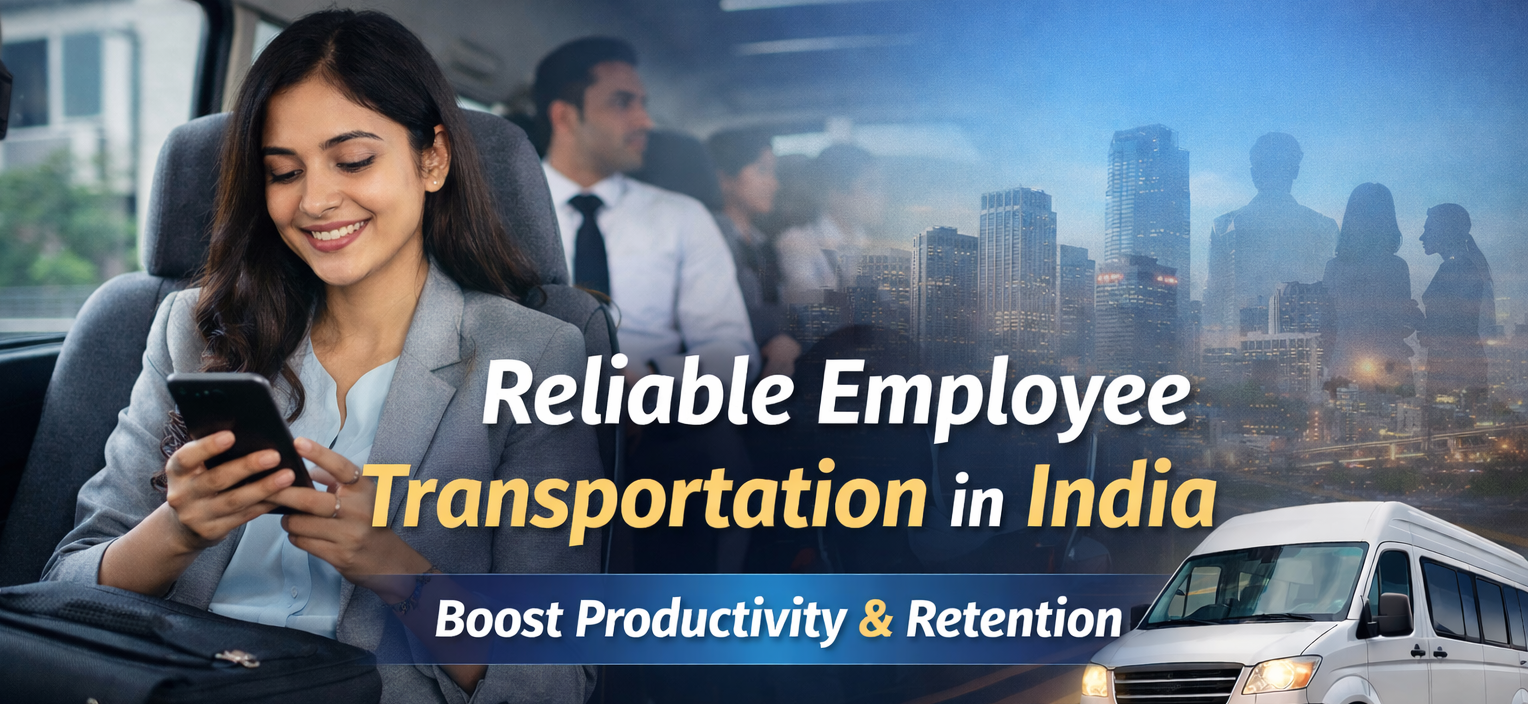
 

How Reliable Employee Transportation Improves Productivity and Retention in Indian Companies

TL;DR

Reliable employee transportation refers to a structured corporate mobility system that ensures punctuality, safety compliance, route optimization, and measurable workforce performance outcomes.

Commute reliability is a direct driver of punctuality, shift adherence, and employee well-being. This article explains how structured corporate transportation reduces absenteeism, lowers attrition, and delivers measurable ROI for Indian organizations through a practical KPI framework that HR and administration teams can implement immediately.


The Commute Is Where the Workday Actually Begins

In India’s major metros such as Delhi NCR, Mumbai, Bangalore, Hyderabad, and Kolkata, the average professional spends over an hour commuting each way. 

According to the Government of India’s Time Use Survey (2019), conducted by the National Statistical Office under the Ministry of Statistics and Programme Implementation, working-age men spend an average of 77 minutes per day on employment-related travel, while women spend approximately 67 minutes.

Late arrivals, missed handovers, early-day fatigue, and reluctance to take late shifts are rarely performance problems at their core. More often, they are commuting problems wearing a performance label. Organizations that treat transportation as a managed system, rather than an incidental facility, consistently outperform those that leave it to chance. For a broader overview of strategic advantages, explore the long-term business value of employee transportation programs.

This article is written for HR and administration teams and business leaders who want to understand the direct link between commute reliability and workforce outcomes and who need a practical framework to act on it.


The Real Business Cost of an Unreliable Commute

Think of commute friction as invisible overhead. It happens before the first login, but it shapes what an employee can realistically deliver once they arrive. The impact accumulates quietly across three dimensions.

Attendance and Punctuality

Traffic congestion, last-minute vehicle breakdowns, and unpredictable routing create arrival variability. In BPO, IT services, healthcare, logistics, and manufacturing environments, where shift transitions and coverage windows determine output, even a 10-minute delay compounds into measurable operational loss. Multiply that across the total site headcount, and the productivity impact becomes measurable.

Cognitive Readiness

Commute stress is cognitive load. Employees who navigate unsafe, unpredictable, or physically exhausting journeys arrive mentally taxed before they log in. A structured commuting system allows employees to begin their day composed and focused, protecting their most productive hours rather than consuming them in recovery.

Attendance Patterns and Leave Behavior

When commuting becomes physically or psychologically draining, employees compensate with leave. This manifests as increased sick days, last-minute absences, and a consistent reluctance to accept late shifts. HR teams frequently categorize this as engagement or well-being issues, without tracing the root cause back to the commute infrastructure.

Common symptoms of commute-linked workforce disruption include:

  • Late arrivals and delayed shift handovers
  • Increased short-notice leave requests
  • Reduced early-day output and focus
  • Repeated escalations to HR and Administration
  • Elevated stress, particularly among late-shift employees
  • Reluctance among women employees to accept late or early shift windows

These are not engagement failures. They are infrastructure failures, and they are addressable.


What Reliable Employee Transportation Actually Means

Reliability is not vehicle availability. It is a system that protects punctuality, safety, and operational transparency at scale. A well-designed corporate transportation program is characterized by five elements.

Shift-Aligned Route Planning

Routes designed around shift clusters and employee pickup density, not a generic loop, reduce detours, shorten pickup windows, and improve ETA accuracy. Route optimization should be continuous, not a one-time configuration.

GPS Tracking and Real-Time Visibility

GPS-enabled fleet monitoring reduces commute anxiety for employees and provides operational control for administrators. When employees can anticipate arrival and observe that the process is actively managed, trust in the system strengthens.

Centralized Monitoring and Escalation Support

When something goes wrong, a no-show, a vehicle breakdown, or an unexpected route disruption, response speed determines the outcome. A dedicated control room with a clear escalation matrix separates enterprise-grade transportation from basic vendor supply.

Safety Protocols for Late Shifts

Reliability without safety does not protect retention. Defined SOPs for late-shift pickups and drop-offs, driver screening standards, and incident handling procedures are non-negotiable, particularly for women employees, for whom safety and predictability carry equal weight.

Organizations that treat commute safety as part of workplace governance increasingly follow structured protocols and documented response frameworks. Implementing best practices for ensuring women employee safety during commutes strengthens both compliance posture and employee trust in late-shift mobility programs.

Reporting and Accountability Frameworks

Transportation becomes manageable only when it is measurable. Regular reporting cadences, reviewed by HR and Administration monthly, allow organizations to treat commuting as governed workforce infrastructure rather than reactive logistics.


Structured vs. Unstructured Commuting: A Direct Comparison

The following comparison illustrates the operational difference between reactive commute arrangements and a structured corporate transport system.

Impact Area Without Structured Transport With Reliable Corporate Transport
Arrival Time Inconsistent; delay-prone Predictable; shift-aligned
Shift Continuity Frequent handover gaps Stable and managed
Employee Energy Drained before work begins Composed and focused
Late-Shift Safety Uncertain; employee anxiety Assured with defined SOPs
HR Escalations Frequent; reactive Controlled; minimal
Attrition Signals Elevated; silent churn Reduced; retention strengthened


The difference is structural, not cosmetic. Organizations competing for talent and operational efficiency in India’s metro markets cannot treat commute reliability as secondary infrastructure.


How Reliable Transportation Strengthens Retention

Retention decisions are shaped by daily experience, and the daily commute is one of the most persistent daily experiences an employee has. Yet commute frustration rarely surfaces explicitly in exit interviews. Instead, it appears as

“I needed a better work-life balance.”

“I found something closer to home.”

“Late shifts were too difficult to manage.”

“I wanted a safer daily routine.”


These responses are commute problems in disguise. When organizations provide reliable, safe, and predictable transportation, they address these attrition drivers before they manifest.

Across industries, this shift is becoming strategic. As discussed in our perspective on why businesses are investing in employee transportation, organizations are increasingly aligning mobility programs with retention, safety compliance, and long-term workforce stability.

A structured commute also signals organizational care. It communicates, concretely and daily, that the company supports employees beyond the office walls. In India’s competitive talent markets, particularly in the IT, BPO, healthcare, and manufacturing sectors, this becomes part of the employer value proposition.

The financial case is equally compelling. Research benchmarks from the Work Institute suggest that replacing a single employee can cost approximately one-third of their annual salary, accounting for recruitment, onboarding, and productivity ramp-up. For organizations running high headcounts across multiple shifts, even marginal improvements in voluntary retention translate into significant cost avoidance.

Reliable corporate transportation is one of the few HR investments with a measurable link to both daily workforce experience and long-term retention outcomes.


Making Transportation Measurable: The Corporate Commute Performance Scorecard

Leadership decisions require data, not intuition. To secure buy-in and demonstrate measurable impact, HR and administration teams need a structured performance scorecard, not broad assumptions.

The six KPIs below provide a comprehensive view of transportation reliability and its direct influence on workforce outcomes. Together, they transform employee transportation from a vendor-managed expense into a governed workforce performance system aligned with productivity, retention, and operational continuity.


KPI What It Measures
Late Arrivals per 100 Trips Punctuality baseline; track weekly after route tuning
Shift Adherence Rate Arrival within required shift window
Absenteeism: Transport vs Baseline Leave trend comparison between transport users and broader workforce
Commute Satisfaction Score Predictability and safety pulse
Incident Response Time Speed from issue to resolution
Cost per Completed Safe Trip Value alignment beyond vehicle spend


These metrics allow HR leaders to quantify transportation impact in terms of punctuality, absenteeism reduction, and retention stabilization.

When these indicators are reported weekly and reviewed monthly, employee transportation transitions from an unmanaged cost line to a continuous improvement program with demonstrable return on investment.

Practical Tip for HR Teams

For the commute satisfaction score, a simple two-question monthly pulse survey is sufficient:

  1. How predictable was your commute this month?
  2. How safe did you feel during your commute?

Even simple responses reveal patterns that complex surveys often miss.


A Phased Implementation Approach

Organizations do not need disruptive overhauls to improve commute reliability. A phased model delivers measurable results quickly while minimizing operational risk.

Phase 1: Assessment (Weeks 1–2)

Identify commute delay patterns, high-density pickup zones, and shift-specific pain points. Review current leave and attendance data for transport-linked correlations. Define four baseline KPIs before any changes are made.

Phase 2: Pilot (Weeks 3–6)

Select one site and two shifts. Implement structured routing with defined pickup windows. Introduce GPS visibility and establish escalation protocols. Collect commute satisfaction feedback from the pilot cohort weekly.

Phase 3: Optimize and Expand (Month 2 Onwards)

Tune routes based on pilot data. Align reporting formats to HR review cycles. Expand gradually to additional shifts and zones once performance benchmarks stabilize. Governance structures should be established before scale, not after.

This approach creates demonstrable proof within weeks and eliminates the risk of a large rollout without baseline data. 


Evaluating a Corporate Transport Partner: What to Look For

Not all transport providers deliver the same level of operational reliability. When evaluating or renewing a vendor relationship, the following criteria separate enterprise-grade partners from basic fleet suppliers.

  • GPS tracking and real-time fleet visibility
  • Shift-based routing with ongoing optimization capability
  • Defined on-time SLA targets and pickup window standards
  • Dedicated escalation support and 24/7 control room coverage
  • Driver screening, training programmes, and performance monitoring
  • Late-shift safety SOPs, particularly for women employees
  • Transparent billing, clear contractual SLAs, and predictable reporting cadence
  • Incident logging with root cause analysis and prevention protocols
  • Scalability across locations and headcount fluctuations
  • HR-ready reporting that supports monthly review presentations
  • A measurable pilot approach before full-scale commitment


A reliable partner should be able to demonstrate each of these capabilities clearly, not as aspirational features but as operational standards with verifiable delivery history.


How Sea Hawk Travels Approaches Employee Transportation

Sea Hawk Travels delivers structured employee transportation services across India’s major business hubs, designed to support workforce continuity, safety, and operational performance at scale.

Our enterprise mobility infrastructure includes:

  • GPS-enabled fleet with centralized operational monitoring
  • Shift-aligned routing with continuous optimization
  • Round-the-clock control room support and structured escalation management
  • Defined late-shift safety protocols, with specific provisions for women employees
  • Multi-city execution across Delhi NCR, Bangalore, Mumbai, Hyderabad, Kolkata, Chennai, Pune, and Indore
  • HR- and Admin-ready reporting frameworks aligned with monthly performance reviews

Our operating model remains consistent across locations: measurable punctuality, governed safety compliance, and transparent reporting aligned with HR and admin review cycles.

If commute instability is affecting attendance, shift adherence, or retention, we take a consultative approach, evaluating existing transport workflows and recommending measurable improvements tailored to your operational footprint.

Request a Transportation Strategy Consultation


Conclusion: Transportation Is a Workforce Strategy, Not a Facility Expense

The commute is not separate from work. It shapes daily readiness, sets the tone for every shift, and influences the long-term calculus employees make about whether to stay or leave. Organizations that manage transportation as structured infrastructure, with defined SLAs, measurable KPIs, and a credible operating partner, position themselves for stronger productivity and lower attrition.

The operational model is clear. The measurable impact is achievable. The only remaining decision is whether transportation will be governed strategically

For organizations operating across multiple Indian metros, structured transportation is no longer a support function; it is workforce infrastructure.


Frequently Asked Questions

Q1. Does reliable employee transportation reduce employee attrition?

Yes. Predictable and safe commuting reduces the daily friction that causes employees to seek alternatives. This is especially true for late-shift employees and women employees, for whom safety and consistency are non-negotiable. Organizations with structured transport programs frequently observe stronger retention trends among employees using company transport compared to non-transport cohorts, particularly in shift-based environments.

Q2. How quickly can organizations see measurable results?

Punctuality and shift adherence improvements often appear within the first pilot cycle, typically 3-6 weeks. Attendance trends stabilize over one to two quarters. Retention impact becomes visible in voluntary attrition data over subsequent review cycles, particularly when tracked against a baseline.

Q3. What does a reliable corporate transport system include?

A reliable corporate transport system typically includes shift-aligned routing, GPS-enabled fleet visibility, centralized monitoring and escalation protocols, defined safety standards for late shifts, driver background verification and training, and structured reporting that HR and administration teams can review regularly.

Q4. Which industries benefit most from structured employee transportation?

IT services, BPO, ITES, healthcare, manufacturing, logistics, and retail operations benefit most due to their shift-dependent structures and large, geographically distributed workforces. However, any organization running multiple shifts or employing over 100 staff in Indian metro regions will see measurable returns.

Q5. How do we evaluate whether our current transport partner is performing?

Track these six indicators: late arrivals per 100 trips (punctuality), shift adherence rate, absenteeism delta, commute satisfaction scores, incident response time, and cost per completed safe trip. If your current provider cannot supply data against these metrics, that itself is a meaningful finding.